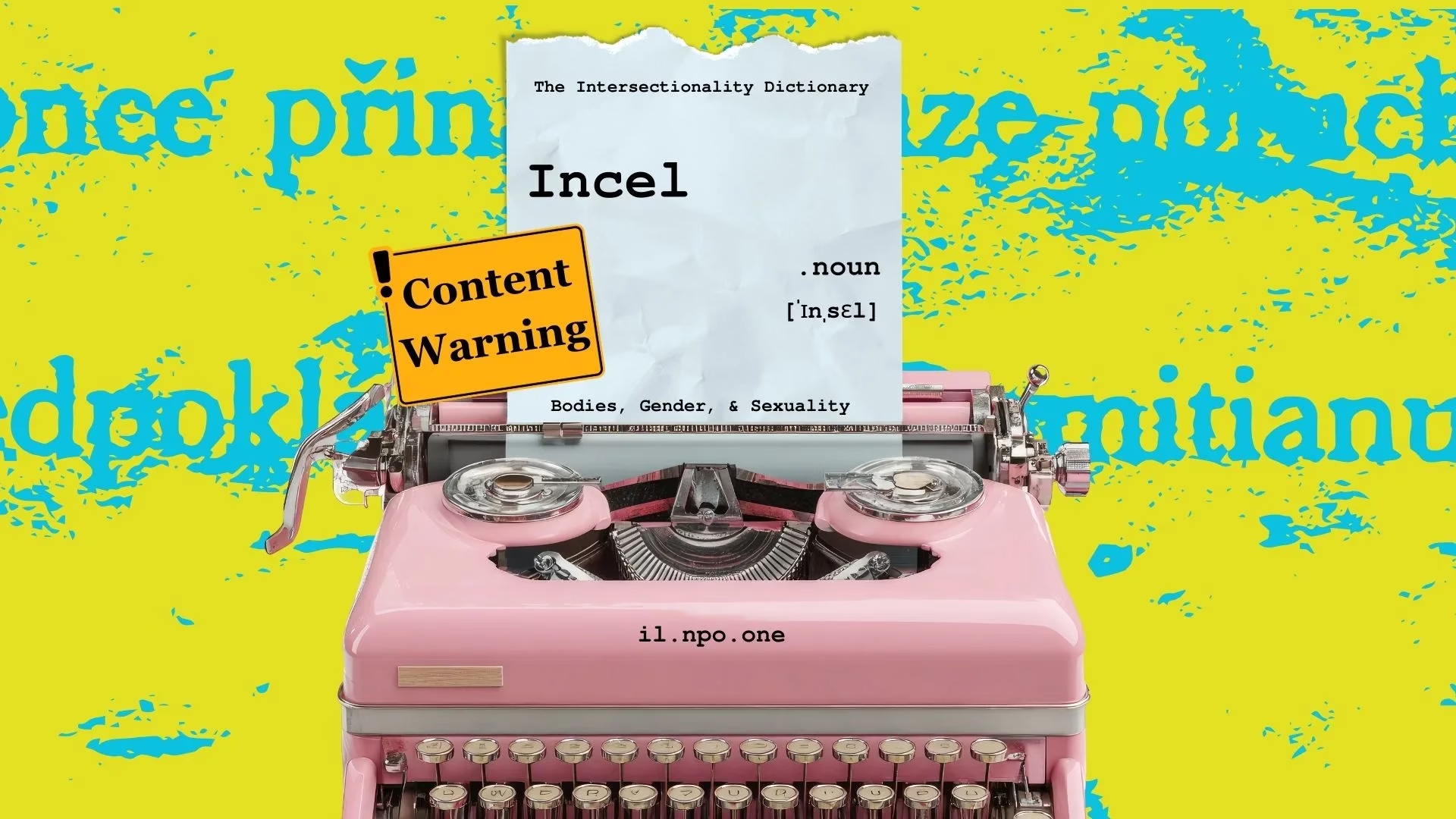
Incel is a term that is used for an involuntary celibate. Celibate usually refers to people who choose to not have sex (Cambridge Dictionary, n.d.). The involuntary aspect of the incel is that the person is unable to find a sexual partner and considers themselves less attractive. These usually heterosexual cis-men believe that society and others place heavy importance on outward appearances, which is why they are at the bottom of the desirability list and are ‘inferior’ to conventionally attractive men (Brace, 2021). These rejections and insecurities cause bitterness and frustration. The following text portrays possible processes of thought patterns and self-victimization that could lead to radicalization. Additionally, it contains some examples of misogynistic hate speech that are not detailed.
Framing & Perspectives
Over the years, many virtual communities have formed where people share their interests and bond online. In the early 2000s and 2010s, many users began to talk about their experiences of perceiving themselves as less attractive men on anonymous websites such as 4Chan or Reddit. They shared such experiences and other life situations, such as their mental health issues, NEET status or financial difficulties, and how this led to rejection and failure in seeking romantic relationships (Zimmerman, 2023). These users noticed that many cis-women would choose conventionally attractive men (called Chads) over them and concluded in the belief that women (and society) only desire and respect a traditionally attractive person. 4Chan and smaller Reddit communities (called subreddits) started gathering a following, becoming echo chambers. Users would often post about their frustrating experiences, which would be met with consolation and support while simultaneously insulting women. After several instances of extreme misogyny and sexism, the r/incel subreddit was banned (Bell, 2017). This led to the creation of the incel website – incel.is (Zimmerman, 2024).
A common theme in Incel online communities was the double standard for women. Many users longed for a romantic partner. However, they complained that women had too many previous relationships. While desiring a sexual partner, but condemning a woman if she only had casual sexual relations (calling her a “slut”). Further, they expressed that women were less worthy than men and made misogynistic remarks such as the woman’s place was in the kitchen. Users also resigned themselves to the fact that they would remain as they were and could not become better people or improve their skills. This self-victimization, along with resistance to change, can lead to a vicious cycle of not liking themselves, having too little self-confidence, being angry at society and women for not desiring them, and eventually giving up on any possibility for change (Helm et al., 2022).
Relevance
In the early 2010s, the term incel was uncommon and was only found on 4Chan and r/incel, but with growing internet use, it has now become a widely used slang. In popular social media such as Instagram and TikTok, the term is being used by Gen Z and Gen Alpha (Solea & Suguira, 2023). It has deviated from its original meaning and can be used to describe a person with no charisma. However, people still use the term when they observe misogynistic behavior online (Willingham, 2023). Sexual liberation movements led to more sexual autonomy and choice. Incels believe that women deny them their ‘right’ to have sex as they choose more attractive partners and label women as vain and oblivious to their uniqueness without self-reflection on their habits (Center on Extremism, 2020). Reacting to the rejection of women, Incels use misogynistic name-calling and insults. Their inability to ‘score’ with a ‘female’, traps them in a vicious cycle of anger and self-victimization while they long for an intimate relationship with the same individuals they insult.
Keywords: Online Subculture, Involuntary Celibacy, Male-Dominated, Sexual Frustration, Anti-Feminism, Misogyny, Radicalization
Connected Terms: Sexism, Hostile Sexism, Internalized Sexism, Reproductive Rights, Body Image, Gender-Based Violence, Sexual Misconduct, “Toxic” Masculinity, Yes Means Yes, Housewifization
References
Bell, C. 2017. “Reddit Bans ‘Involuntarily Celibate’ Community.” BBC News, 9 November 2017. https://www.bbc.com/ news/blogs-trending-41926687
Brace, L. (2021, August 26). A short introduction to the involuntary Celibate Sub-Culture. Centre for Research and Evidence on Security Threats. https://crestresearch.ac.uk/resources/a-short-introduction-to-the-involuntary-celibate-sub-culture/
Celibate – Cambridge Dictionary. Retrieved 18.02.2025 from CELIBATE | meaning – Cambridge Learner’s Dictionary
Center on Extremism. (2020, July 29). Incels (Involuntary celibates). ADL. https://www.adl.org/resources/backgrounder/incels-involuntary-celibates
Helm, B., Scrivens, R., Holt, T. J., Chermak, S., & Frank, R. (2022). Examining incel subculture on Reddit. Journal of Crime and Justice, 47(1), 27–45. https://doi.org/10.1080/0735648x.2022.2074867
Solea, A.I., Sugiura, L. Mainstreaming the Blackpill: Understanding the Incel Community on TikTok. Eur J Crim Policy Res 29, 311–336 (2023). https://doi.org/10.1007/s10610-023-09559-5
O’Malley, R. L., Holt, K., & Holt, T. J. (2020). An exploration of the involuntary Celibate (InCEL) subculture online. Journal of Interpersonal Violence, 37(7–8), NP4981–NP5008. https://doi.org/10.1177/0886260520959625
Willingham, A. (2023, March). What does the term ‘incel’ mean? CNN. https://edition.cnn.com/2023/03/16/us/incel-involuntary-celibate-explained-cec/index.html
Zimmerman, S. (2024). The ideology of incels: Misogyny and victimhood as justification for political violence. Terrorism and political violence, 36(2), 166-179.