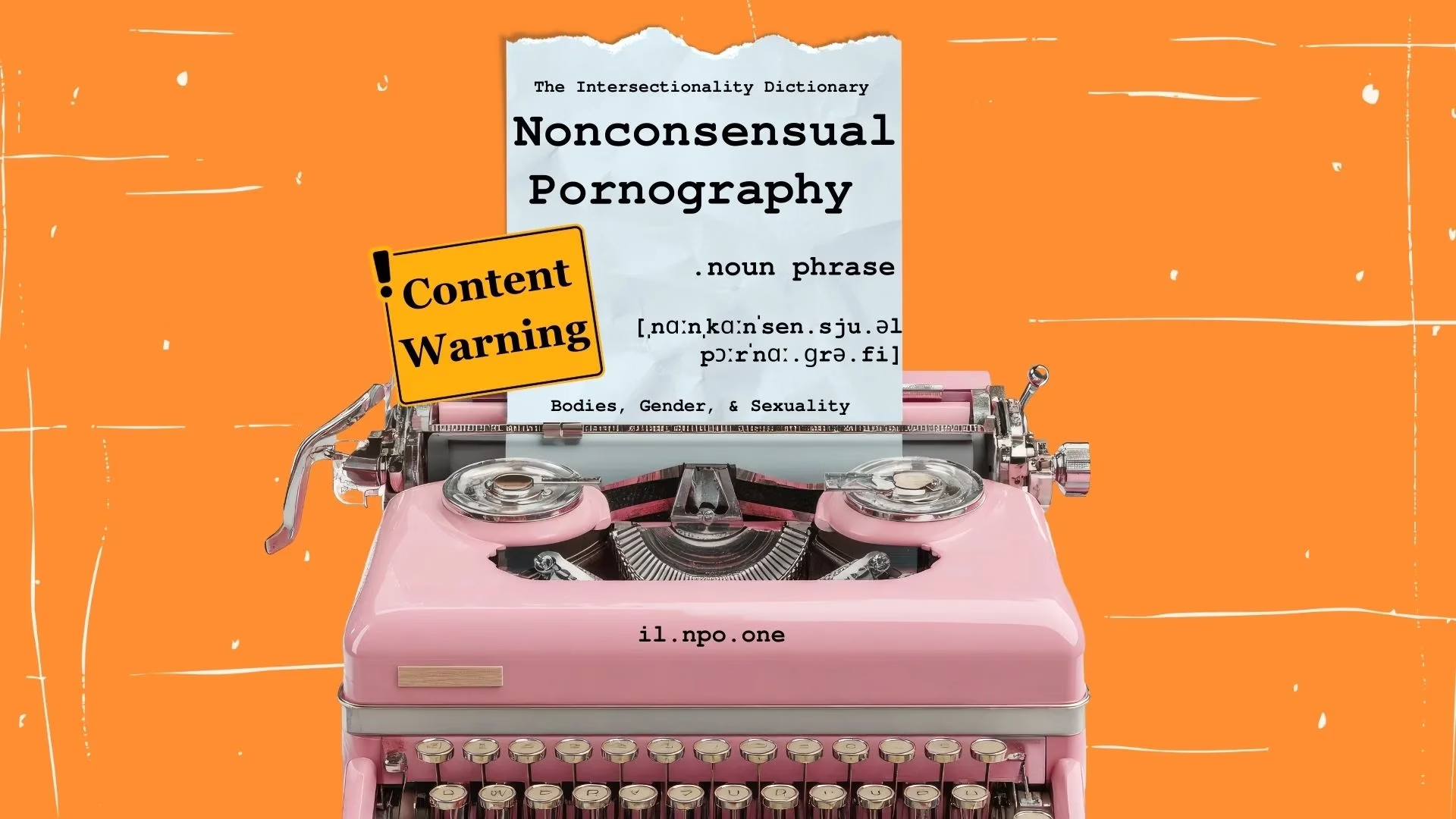
Nonconsensual pornography (NCP) is the online distribution of sexually graphic photographs or videos of individuals without their permission (European Institute for Gender Equality, 2017). Ex-partners may distribute nonconsensual pornography after a breakup, which is a crime in most countries. Targets of nonconsensual pornography can also be victims of cyber attacks, where hackers may get access to personal data via online storage. The following text mentioned a type of sexual violence that happens through an individuals invasion of privacy by their partner. It also gives examples of some cases of sexual harassment that is the result of the invasion of privacy.
Framing & Perspectives
While controversial and risque paintings have existed since the dawn of time, the introduction of photography changed the landscape of suggestive media. In 1888, a 30-something Le Grange Brown in New York had been selling indecent pictures of high society ladies. He had done so by taking photographs of these ladies and then cutting and pasting the photos of their heads onto images of naked women (Lake, 2021).
As such crimes become increasingly common, many countries have begun to pass laws to protect the dignity of the targets. With the rise of online spaces, sharing on media has become more accessible. The use of technology to sustain personal and intimate relationships has become a daily matter, as people use WhatsApp or Instagram to keep in touch with their loved ones. It has also become common for people in relationships to send intimate and explicit pictures to their partners (Northern Territory Law Reform Committee, 2016). When sexually explicit images of a partner are publicly shared by their current or former partner, with the intent of retaliation or hurting the person, it is called revenge porn and falls under intimate partner violence. Access to such media has also become easier as there are several websites and forums where people share their (ex) partner’s explicit pictures or videos. Some may go so far as to share the partner’s name or other details, which is called doxxing (Maddocks, 2018). This exposes the targeted person to harassment by other internet users and can lead to exclusion, ostracization, or death of the victim (Dutta, 2018).
The use of AI and deepfakes has complicated the issue of nonconsensual pornography, creating a new challenge of what is real and what is fake. Deepfake is a new method of technology that uses AI to create hyperrealistic videos and pictures with almost no signs of manipulation (Chadha et al., 2021). This manipulation can allow people to create explicit pictures of others, with their existing pictures found publicly, without having to be hacked. Thousands of pornographic videos can be found that use deepfakes to gather a niche audience that wants explicit imagery of a specific person who may be a celebrity, a social media influencer, a neighbor, or even children (Westerlund, 2019).
Relevance
Nonconsensual pornography in recent years has occurred in many forms. Celebgate or ‘The Fappening’ [sic] was a major iCloud leak where explicit and semi-nude pictures of several celebrities were released in 2014 (BBC News, 2016). While there was public outrage and shock, many people also commented on a leak being inevitable if nudes (explicit pictures of oneself) were taken. The belief that ‘they deserve it’ shifts the narrative and places blame and responsibility for the leak on the victim rather than the perpetrator (Mckinlay & Lavis, 2020).
In South Korea, the issue of hidden cameras has become so prevalent that they coined the term ‘molka’, which is a portmanteau for two Korean words – (kamera) camera and (mollae) hidden (Molisso, 2023). Similar to upskirting, molka is when spy cameras are arranged and hidden inside public rooms, such as changing rooms, toilets, or hotel rooms. Thousands of videos of hidden cameras were found in several Telegram groups and digital spaces (Molisso, 2023). Such an invasion of privacy has caused distress amongst South Korean women who now often use anti-molka devices to check public rooms before use. Appropriate laws and regulations need to be established to ensure that such victims are brought to justice and such practices are banned from society.
Keywords: Bodily Autonomy, Sex Work, Sexual Harassment, Privacy Rights
Connected terms: Victim Blaming, Bodily Autonomy, Consensual Pornography, Sexual Misconduct, Human Trafficking, “Toxic” Masculinity, Yes Means Yes, Unionisation, Incel
References
BBC News. (2016, March 16). Meet the man behind the leak of celebrity nude photos, called the fappening. https://www.bbc.com/news/newsbeat-35820521
Chadha, A., Kumar, V., Kashyap, S., & Gupta, M. (2021). Deepfake: An Overview. In Lecture notes in networks and systems (pp. 557–566). https://doi.org/10.1007/978-981-16-0733-2_39
De Angeli, A., Falduti, M., Menendez-Blanco, M., & Tessaris, S. (2023). Reporting non-consensual pornography: clarity, efficiency and distress. Multimedia Tools and Applications, 82(9), 12829–12858. https://doi.org/10.1007/s11042-022-14291-z
Dutta, K. (2018, March). Bengal Woman Commits Suicide after School Students Post Nude Photos Online. Hindustan Times. https://www.hindustantimes.com/kolkata/bengal-womancommits-suicide-after-school-students-post-nude-photos-online/story-7UPwPHMgNN2NgcFJeRYmtM. html
Eaton, A. A., Noori, S., Bonomi, A., Stephens, D. P., & Gillum, T. L. (2020). Nonconsensual porn as a form of intimate partner violence: Using the power and control wheel to understand nonconsensual porn perpetration in intimate relationships. Trauma Violence & Abuse, 22(5), 1140–1154. https://doi.org/10.1177/1524838020906533
European Institute for Gender Equality [EIGE]. (2017). Cyber violence against women and girls. European Institute for Gender Equality. https://doi.org/10.2839/876816
Lake, J. (2021, September 23). In the 19th century, a man was busted for pasting photos of women’s heads on naked bodies . . . sound familiar? The Conversation. https://theconversation.com/in-the-19th-century-a-man-was-busted-for-pasting-photos-of-womens-heads-on-naked-bodies-sound-familiar-168081?utm_source=clipboard&utm_medium=bylinecopy_url_button
Maddocks, S. (2018). From Non-consensual Pornography to Image-based Sexual Abuse: Charting the Course of a Problem with Many Names. Australian Feminist Studies, 33(97), 345–361. https://doi.org/10.1080/08164649.2018.1542592
Mckinlay, T., & Lavis, T. (2020). Why did she send it in the first place? Victim blame in the context of ‘revenge porn.’ Psychiatry, Psychology and Law, 27(3), 386–396. https://doi.org/10.1080/13218719.2020.1734977
Molisso, S. (2023). Molka: Consent, Resistance, and the Spy-Cam Epidemic in South Korea. In Consent: Gender, Power and Subjectivity (1st ed., pp. 221–233). Routledge. https://doi.org/10.4324/9781003358756-20
Northern Territory Law Reform Committee. (2016). Report on the Non-Consensual Sharing of Intimate Images (Report No. 43). Northern Territory Government. https://justice.nt.gov.au/__data/assets/pdf_file/0011/425666/Northern-Territory-Law-Reform-Committee-Report-on-the-Non-Consensual-S. . ..pdf
Westerlund, M. (2019). The Emergence of Deepfake Technology: A review. TIM Review. https://timreview.ca/article/1282